
|
|

 FILM
LIGHTS
SOUND
CAMERA
EDIT
FILM
LIGHTS
SOUND
CAMERA
EDIT
|
|
|
|
|
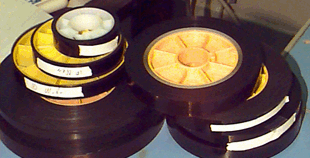 This "work print" is printed sort of the way photographs are printed from negative onto paper. Instead, these thousands of frames are printed into a new piece of film as positive images. These films are all - of course - cellulose acetate.
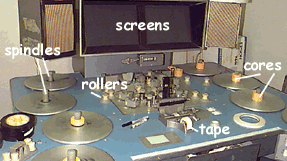 When everything is printed and transferred and back from the lab, then we have to synchonize it all. The best way is to look at the film and mark each frame where the slate claps, and then mark the sound track at the exact point where the clapboard hits. This is easily done on a flatbed editor like this Steenbeck machine, which itself has a few polymer features, like all the polyethylene spindles and those little nylon rollers and the diffuse Plexiglass screens where the images are projected through a prism and a mirror.
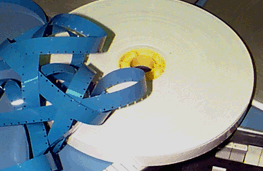 We can also put it in place of shots that need to be redone or have't been shot yet, just to get the timing ot a scene right. We also use it to fill the gaps in the multiple soundtracks that we will be using. And you just thought this leader stuff went at the beginning of all those cheesy old films that you watched in elementary school... Wait, you may not be that old, but some of us remember it.
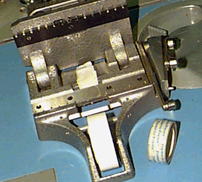 So how do we get it all to stick together? Well, at this point nothing is permanent. All editing decisions can be changed, so we use a lot of SPLICING TAPE. We use clear for picture, and the thicker white for sound. Fortunately both types of "film" can be cut and spliced with the same splicer, but constantly switching out the tape can make life rough for the editor.
And now something you might have noticed everywhere - these little yellow cores. They are also made of hard polystyrene, and they are very important in the editing process. The further we get into the edit,Once the work print and all the soundtracks (There can be as many as twelve or twenty-four - or more - on major motion pictures) are the way we want them, we LOCK the tracks, which is a filmy way of saying we declare the thing finished.the more of these things we need as we break down scenes and separate different soundtracks, like the dialogue track and the sound effects and the music. Each reel needs its own core. It is not unusual to use 50 to 100 cores when editing a short film. It may seem a precarious way to store film, and it is. Bigger reels must be handled with care so that the core doesn't slip out of the center, but cores make the film easier to load onto different types of editing machines and projectors. There are special "split reels" with removable flanges that can be put onto a projector or a bench editor and then removed from the core when the work is done.
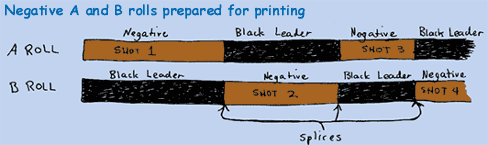
 This is important because once we mix the soundtracks there's no going back. So while the soundtracks are at the sound engineer being mixed onto a single track of mag stock, some very precise person has to match the camera negative to the work print. It takes a long time to go back through all the original rolls of film and find just the little pieces that you used in the final edit, but it can be done with a system of edge numbers which are the same on workprint and negative.
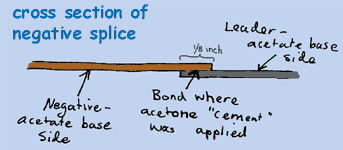 The edges of the film are brushed with cement and then set in perfect alignment in the heat splicer. The low heat on the splicing block mainly speeds up the drying process which fuses the film together once the solvent has all evaporated. So a good film splice should act as if it is a single unbroken piece of film.
These days new digital media has caused a lot of changes in the film production process. Amateur filmmakers are turning to digital video, mostly for the sake of convenience and availability of consumer level computer based editing. However, after dubbing and editing suite time are figured in, broadcast qulaity professional video comes out costing almost as much as film. Digital editing of film has taken some of the steps out of the process, including workprint, mag sound track and actual cutting of the film. But nothing invented to date has been able to match the light sensitivity and resolution of film, so the negative, the release print, and good old-fashioned film shoots are bound to be around for a good long time. In fact some editors still prefer to work all the old fashioned way. There is something in the time it allows one to think about what one is doing, as well as the feel of actually working with the film itself, that makes the editing process valuable.